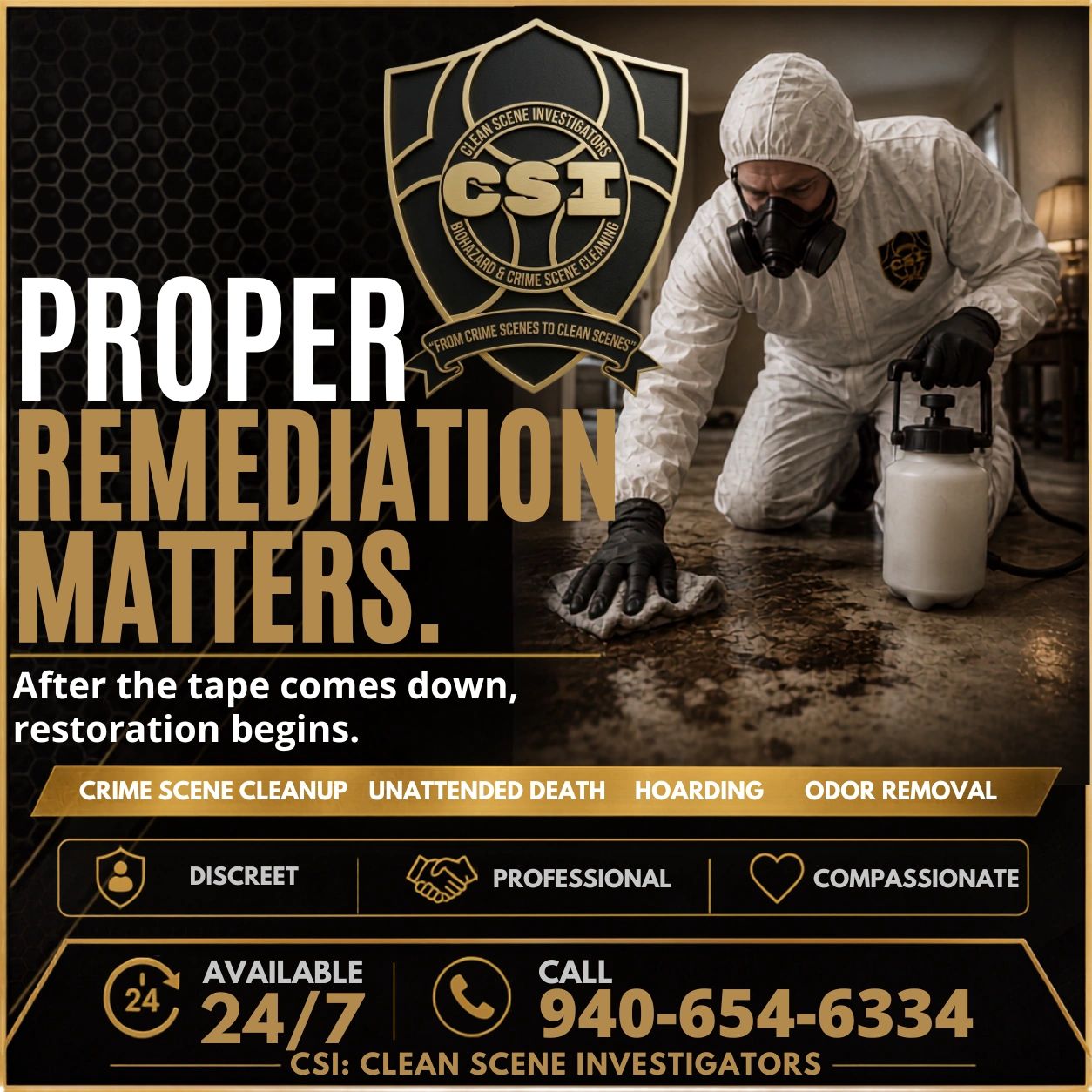
When the Crime Scene Is Over, the Risk Isn’t
The police have left.
The investigators have finished their work.
The ambulance is gone.
The property has been released.
For the people left behind, it can feel like the emergency should finally be over.
But when blood, bodily fluids, or other biological material remain inside a home, vehicle, apartment, business, or other property, the physical hazard may still be there.
That is why one of the most important things families and property owners should understand after a traumatic event is simple:
When the scene is over, the risk isn’t.
Crime scene cleanup and biohazard remediation begin where the work of law enforcement, emergency medical personnel, and investigators ends.
CSI: Clean Scene Investigators provides professional crime scene, trauma, and biohazard cleanup throughout DFW, Denton County, and North Texas.
Our job is not to investigate what happened.
Our job is to safely address what was left behind.
What Happens After Police Release a Crime Scene?
Police departments and Crime Scene Investigators have a specific responsibility at a scene.
They may document evidence, photograph the property, collect physical evidence, conduct interviews, process bloodstain patterns, document firearms evidence, or complete other investigative tasks.
Emergency medical personnel have their own responsibilities.
Medical examiners and funeral professionals have theirs.
But none of those responsibilities normally include restoring the affected property.
Once authorities officially release the scene, the family, property owner, landlord, business owner, property manager, or another responsible party may suddenly be faced with blood, bodily fluids, contaminated materials, damaged flooring, affected furniture, or other remnants of the event.
That is where a professional biohazard remediation company comes in.
Why Blood Cleanup Is More Than Cleaning What You Can See
One of the biggest misconceptions about trauma cleanup is that if the visible blood is gone, the problem is solved.
It may not be.
Blood and other biological fluids can travel farther than they initially appear to.
They can seep into:
- Carpet
- Carpet padding
- Subflooring
- Hardwood
- Laminate flooring
- Tile grout
- Baseboards
- Drywall
- Furniture
- Mattresses
- Upholstery
- Concrete
- Vehicle carpet
- Vehicle seats
- Interior trim
- Structural materials
The contamination you see on the surface may only be part of the affected area.
For example, blood on a carpet may have passed through the carpet fibers and padding and reached the subfloor underneath.
Cleaning the top of the carpet would not necessarily address the contamination below it.
That difference is what separates biohazard remediation from ordinary cleaning.
Why Blood and Bodily Fluids Require Proper Remediation
Blood and certain bodily fluids must be treated seriously because they may carry bloodborne pathogens.
This is why professional trauma and biohazard cleanup requires appropriate protective equipment, cleaning procedures, disinfectants, containment practices, and waste handling.
A professional cleanup may involve:
- Identifying affected areas
- Evaluating how far contamination traveled
- Removing materials that cannot be properly restored
- Cleaning affected nonporous surfaces
- Applying appropriate disinfectants
- Addressing contamination beneath flooring or behind structural materials
- Packaging contaminated waste
- Controlling biological odors
- Preventing cross-contamination into unaffected areas
The exact remediation process depends on what occurred, the amount of contamination, the materials involved, and how long the biological material has been present.
No two scenes are identical.
Why Household Bleach Is Not the Entire Answer
A common reaction after discovering blood is to reach for household bleach.
But effective biohazard remediation is not simply about selecting a strong cleaning chemical.
The bigger question is:
Where did the contamination go?
If blood soaked through carpeting and into padding, cleaning the surface does not solve the problem underneath.
If biological fluids reached the seam between flooring and a wall, contamination may have traveled beneath the baseboard.
If decomposition fluids penetrated a porous material, spraying the surface may not eliminate the source.
Proper remediation focuses on identifying and removing or treating the source of contamination, not merely improving the appearance of the area.
Crime Scene Cleanup After a Shooting or Traumatic Injury
A shooting, assault, accident, suicide, or other traumatic event can create contamination across multiple surfaces.
Depending on the circumstances, biological material may affect:
- Walls
- Ceilings
- Flooring
- Furniture
- Personal belongings
- Doorways
- Adjacent rooms
- Vehicles
- Outdoor surfaces
What may appear to be a small affected area can sometimes involve multiple surfaces or hidden contamination.
This is another reason a professional assessment is important.
What About an Unattended Death?
An unattended death creates a different set of remediation challenges.
When a person passes away and is not discovered immediately, natural decomposition begins.
As time passes, biological fluids and odor compounds may affect nearby materials.
Contamination can potentially reach:
- Mattresses
- Furniture
- Flooring
- Carpet padding
- Subflooring
- Concrete
- Baseboards
- Drywall
- Personal belongings
- Other porous structural materials
Odor is often one of the first things people notice.
But odor removal is not simply about spraying fragrance into the room.
If biological material remains inside or underneath a porous surface, that material may continue producing odor.
Effective decomposition odor remediation begins by locating and addressing the source.
Why Crime Scene Cleanup Is Not Routine House Cleaning
Crime scene and trauma cleanup are fundamentally different from routine residential cleaning.
Routine cleaning is designed to remove normal dirt, dust, grime, and household contamination.
Crime scene remediation may involve potentially infectious biological material, contaminated building materials, bloodborne pathogen concerns, regulated waste, decomposition, and environments connected to traumatic events.
That difference affects everything from protective equipment to disposal procedures.
CSI: Clean Scene Investigators is specifically focused on situations involving:
- Crime scene cleanup
- Blood cleanup
- Trauma cleanup
- Biohazard remediation
- Unattended death cleanup
- Decomposition cleanup
- Hoarding remediation
- Forensic odor removal
- Vehicle biohazard cleanup
- Extreme environments involving biological contamination
A Former Crime Scene Investigator on the Cleanup Side
CSI: Clean Scene Investigators was founded by Christina Hester, a former Crime Scene Investigator.
That background provides a unique perspective on what happens before a cleanup company ever enters the property.
As a Crime Scene Investigator, the focus is documentation, evidence, preservation, and determining what happened.
As a biohazard remediation company, the focus changes.
Now the question becomes:
What biological contamination remains, where did it travel, what materials were affected, and what needs to happen to make the environment safer again?
CSI combines forensic attention to detail with a trauma-informed approach to the people experiencing the aftermath.
Because the property matters.
But so does the person standing inside it.
Trauma-Informed Crime Scene Cleanup Matters
Families do not call a trauma cleanup company because they are having a normal day.
Someone may have just experienced:
- The death of a loved one
- A suicide
- A homicide
- A serious injury
- An unattended death
- A traumatic discovery
- A severe hoarding situation
- A biohazard event inside their home or vehicle
That changes how communication should happen.
Clients should not be treated like another work order.
They deserve clear explanations, discretion, compassion, and professional boundaries during an extremely difficult moment.
That is why trauma-informed service is part of how CSI approaches these situations.
Who Cleans Up a Crime Scene in Denton, DFW, and North Texas?
CSI: Clean Scene Investigators provides crime scene and biohazard cleanup throughout Denton County, DFW, and surrounding North Texas communities.
Our service area includes communities such as:
- Denton
- Lewisville
- Little Elm
- Corinth
- Lake Dallas
- Argyle
- Aubrey
- Sanger
- Krum
- Ponder
- Cross Roads
- Surrounding DFW and North Texas areas
CSI provides 24/7 response for urgent trauma and biohazard situations.
Frequently Asked Questions
Do police clean up blood after a crime scene?
Generally, no. Law enforcement is responsible for investigating the incident and collecting evidence. Once the scene is released, cleanup is typically handled separately by the property owner or a professional crime scene and biohazard remediation company.
Who cleans blood after someone dies at home?
A professional trauma or biohazard remediation company can clean blood, bodily fluids, and affected materials after a death inside a residence.
Is blood still hazardous after it dries?
Dried blood should still be treated as potentially hazardous. Appropriate precautions should be used when handling blood-contaminated materials.
Can blood soak through flooring?
Yes. Blood and other fluids may penetrate carpeting, carpet padding, wood, seams, subflooring, and other porous materials depending on the amount and circumstances.
Does cleaning visible blood remove all contamination?
Not necessarily. Biological material may have traveled underneath or behind the visible surface.
Who handles unattended death cleanup?
Companies specializing in unattended death and decomposition remediation can remove contaminated materials, clean and disinfect affected areas, and address odor sources.
Can decomposition odor be removed?
In many situations, yes, but successful odor remediation depends on identifying and addressing the biological source rather than simply masking the smell.
Is crime scene cleanup the same as regular cleaning?
No. Crime scene cleanup can involve bloodborne pathogen concerns, biological contamination, contaminated structural materials, specialized protective equipment, and regulated waste handling.
Is professional crime scene cleanup available in Denton, Texas?
Yes. CSI: Clean Scene Investigators provides crime scene, trauma, biohazard, unattended death, decomposition, blood, odor, hoarding, and vehicle biohazard cleanup in Denton and throughout surrounding North Texas communities.
What Should You Do If a Crime Scene Has Just Been Released?
If authorities have released a property and blood or biological material remains:
- Confirm that law enforcement has officially released the scene.
- Keep children, pets, and unnecessary visitors away from the affected area.
- Avoid touching or moving visibly contaminated materials.
- Do not attempt to hide biological odors with fragrances.
- Contact your insurance carrier if you plan to investigate possible coverage.
- Contact a professional crime scene and biohazard remediation company for guidance.
The most important thing to remember is that you do not automatically have to clean the physical aftermath yourself.
When the Scene Is Over, the Risk Isn’t
The conclusion of the investigation does not necessarily mean the property is ready to return to normal use.
Blood, bodily fluids, decomposition material, and hidden biological contamination may remain long after investigators have completed their work.
That is the gap professional crime scene remediation exists to fill.
CSI: Clean Scene Investigators provides 24/7 crime scene, trauma, biohazard, unattended death, decomposition, forensic odor, hoarding, and vehicle biohazard cleanup throughout DFW and North Texas.
When the scene is over, the risk isn’t.
And you should not have to face the cleanup alone.
CSI: Clean Scene Investigators 24/7 Response: 940-654-6334 https://cleansceneinvestigators.com